
Kabo vs Exolyt at a glance
A monitoring project and a filming brief require different kinds of continuity.
| Your task | Kabo | Exolyt |
|---|---|---|
| Account and video research | Develop questions Interpret available material and follow up. | Monitor patterns Track accounts, posts and historical changes. |
| Trends and conversations | Investigate a brief Research a topic or reference for a specific decision. | Maintain projects Track sounds, hashtags and listening topics. |
| AI assistance | Research to writing Revise directions, shots, voiceover and captions. | Analysis and ideation AI summaries and a Content assistant. |
| Ongoing team reporting | Conversation output Reports and drafts from the task you request. | Tracked intelligence Plan-based history, refresh rates and project limits. |
Why compare Kabo and Exolyt?
“Which competitors gained attention this month?” calls for consistent tracking and history. “What can our next video learn from these posts?” calls for interpretation and a creative decision.
For a client report, evaluate coverage, refresh frequency and listening capacity. For a creator brief, look for a supported pattern and an original direction you can film.
Exolyt: ongoing TikTok monitoring and social intelligence
Exolyt’s account overview helps follow profile and post performance. Sound and hashtag tracking add trend context. Social listening supports ongoing work around brand mentions, share of voice and sentiment.
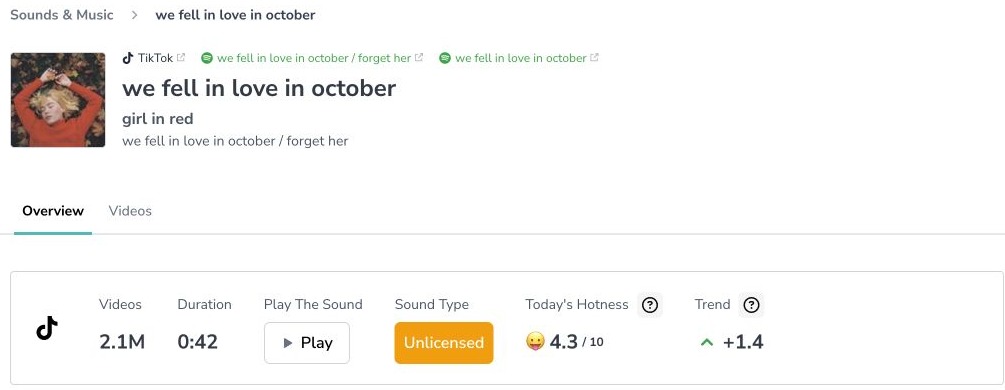
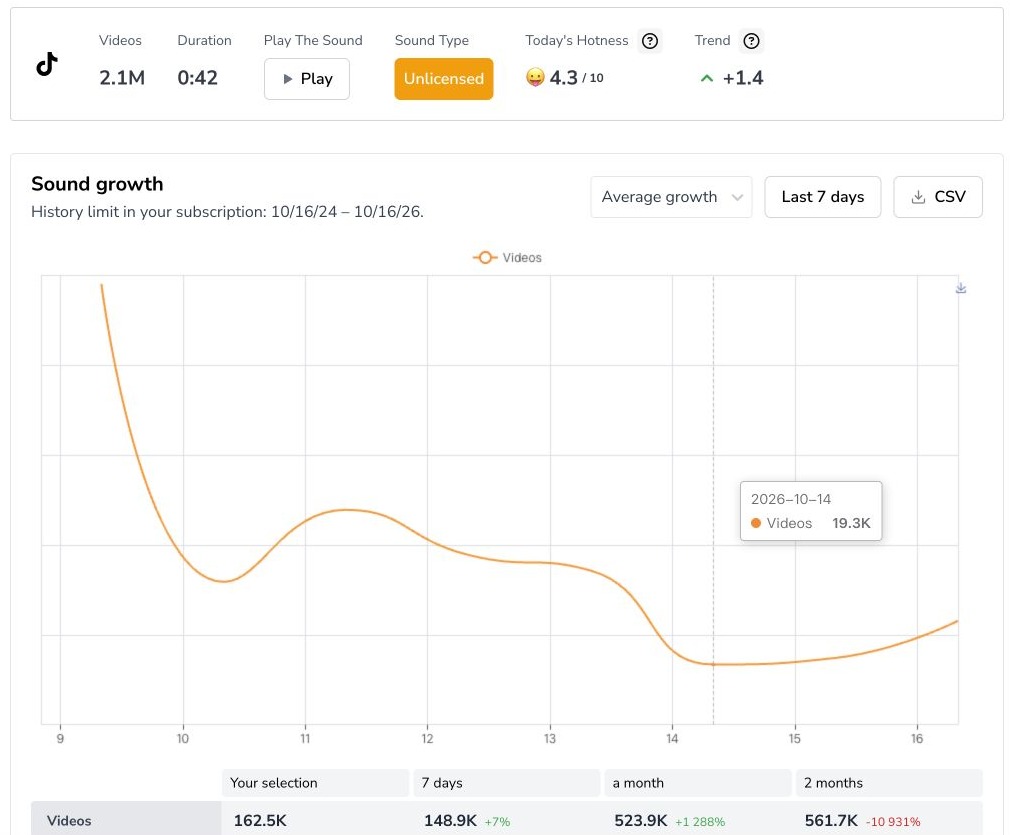
Its sound views show why history matters. An overview gives you the adoption snapshot; the growth chart adds a selected time window. A team evaluating a trend can use that history to distinguish continued uptake from an isolated high total, over time.
Exolyt also offers AI summaries and a Content assistant. If you already use it for monitoring, check whether its ideation workflow covers your brief before adding another subscription. Kabo is worth considering when you want to keep questioning references and revising the resulting draft through conversation.
Kabo: account and video questions you can keep developing
Start Kabo with an account link, a video reference or a question about your audience. Its account analysis can organize public posts and identify topics worth investigating. Its video analysis workflow helps examine an individual reference when the necessary source material is available.
The AI Agent lets you connect the account view to a specific creative task. Ask which patterns recur, select two relevant examples, then explore what can transfer to a different subject. Add constraints such as one person filming, ordinary kitchen equipment or a 25-second runtime. Revise the chosen idea’s shots, voiceover and caption in the same conversation.
Captions can reveal framing; claims about editing or delivery need relevant transcripts or visual evidence. Ask what supports an observation before adopting it.
From public posts to an original cookie video
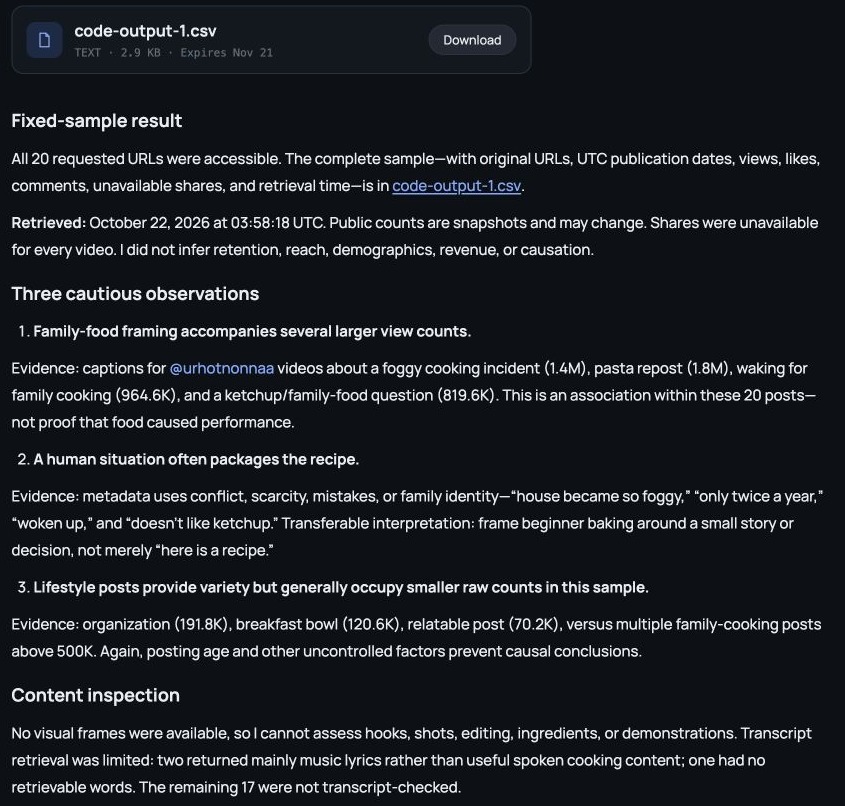
In the Kabo example below, research on 20 public posts from @urhotnonnaa produced an account report and a CSV of the source posts. One useful observation was that several larger-view posts framed cooking through family situations or small conflicts. That offered a creative starting point, without establishing why those posts attracted views.
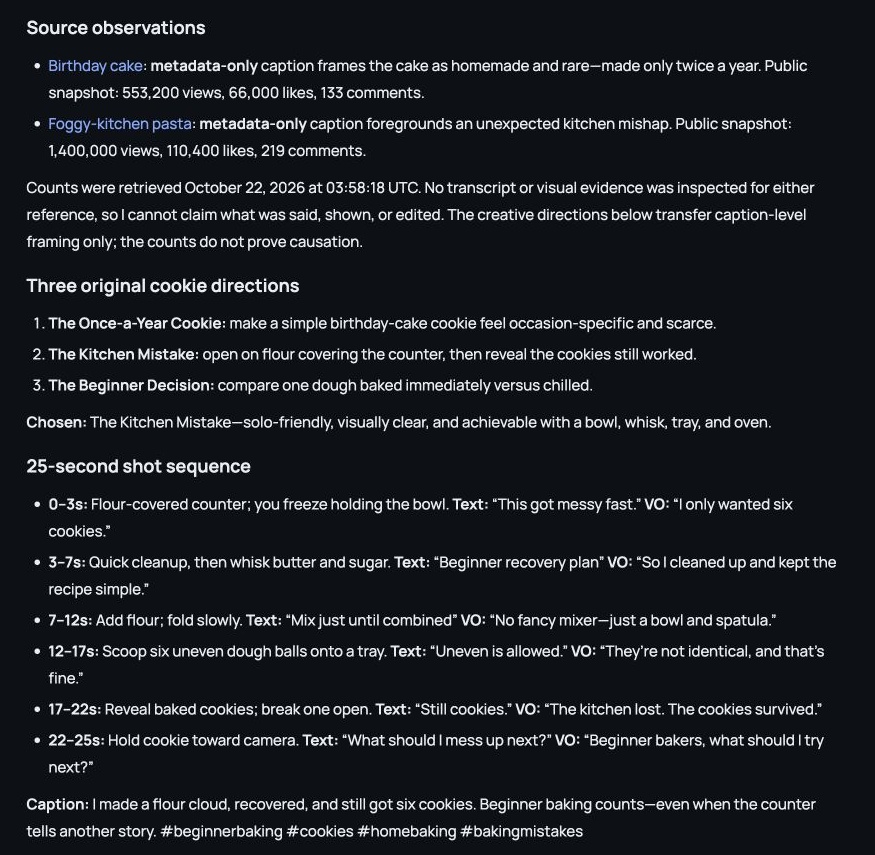
A follow-up drew on two caption-level references: a rarely made birthday cake and an unexpected kitchen mishap. Kabo proposed three original cookie directions: an occasion-specific cookie, a flour-covered-counter mishap and a comparison of immediately baked versus chilled dough. The chosen “Kitchen Mistake” concept suited a solo creator with a bowl, whisk, tray and oven.
The 25-second draft opens on a messy counter with “I only wanted six cookies,” moves through recovery and mixing, shows uneven dough balls and reveals the finished cookies. It includes shot timing, screen text, voiceover and a caption. The useful transfer is the small-story framing, adapted into a new subject and feasible shoot.
That is a concrete handoff from research to script writing. The example used metadata and captions, without inspected video frames or reliable spoken-content coverage. It demonstrates original development from limited references, rather than a reconstruction of the source videos.
Plans: daily research credits versus tracked projects
Kabo has daily free credits and a $7.99/month Pro plan, with allowances for research and premium tasks. Exolyt’s limits revolve around tracked objects, listening projects and historical coverage.
Exolyt Basic is free, with one tracked account, hashtag and sound, seven days of history and no social-listening projects. Essentials is $400/month, or $330/month billed annually; Advanced is $950/month, or $790/month billed annually. They expand tracking and listening capacity; Advanced also includes capabilities such as sentiment and transcripts.
For ongoing client work, price the number of accounts and projects you need to maintain. The Exolyt screenshots show Advanced-trial access, so use the plan table to check what remains available after a trial.
Choose around the output your team needs
If your team must report how a competitor or conversation changed since last month, Exolyt’s monitoring model is the closer fit. If the next handoff is a shoot brief, use Kabo to connect the references to a concept and script. A monitored signal can also become the starting point for that conversation.
Kabo vs Exolyt FAQ
Does Kabo replace continuous social listening?
Choose a dedicated monitoring product when you need maintained listening projects, scheduled updates and historical reporting. This Kabo example does not establish equivalent coverage.
Can Exolyt help generate ideas?
Yes. Its Content assistant supports ideation. Compare the actual workflow and required plan rather than treating AI as exclusive to either tool.
Can Kabo analyze private competitor metrics?
Public research does not reveal private retention or conversion data. Use authorized first-party analytics for accounts you manage.
Sources and scope
Published by Kabo. Exolyt sound views are from an October 16 Advanced trial; ongoing listening features follow official documentation. Kabo’s October 22 example used 20 supplied URLs, with no missing URLs, but metrics were not independently validated and shares were unavailable. Neither example establishes publishing outcomes.
USD prices checked October 22, 2026. Plans and allowances can change.