
Okay, why is that drink floating?
A cup in the middle of the street. No hand. No table. Just… there.
Then someone walks into frame and notices it. Now you’re waiting for the grab.
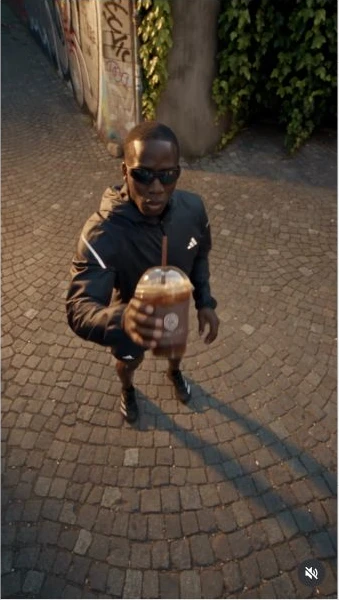
Both Reels use that same little setup: The Lit Social Club with a strawberry matcha, Kenny’s Café with an iced drink and a passing runner.
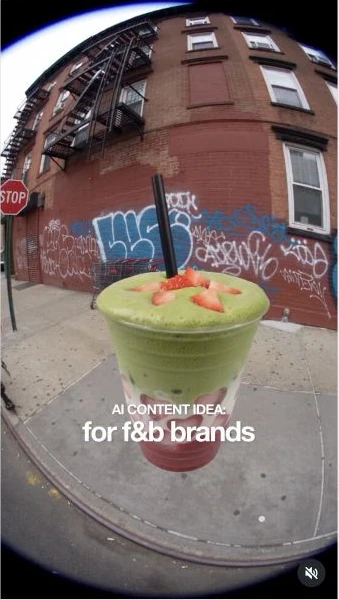
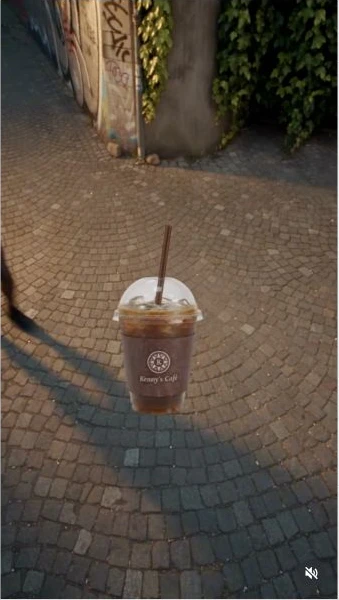
The float gets your attention. What happens around it gives you a reason to keep watching.
01. Something familiar looks a little impossible.
You know what a takeaway drink looks like. You also know it shouldn’t be hovering above a sidewalk.
That’s the opening, right there.
At roughly 0:00–0:01, both cups are already in the foreground. No slow reveal. No explanation before the interesting bit.
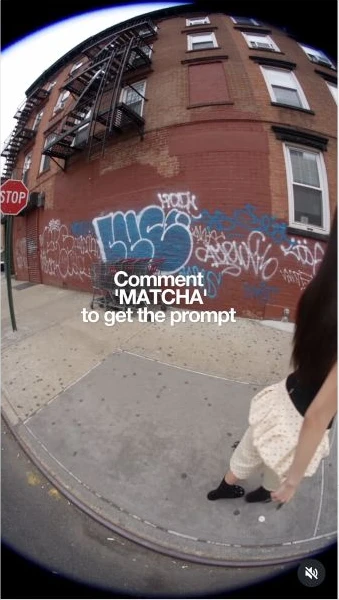
The matcha’s green and red layers stand out against the brick wall. The fisheye view makes the whole street feel slightly off. Kenny’s Café keeps its branded cup easy to see against the cobbles.
Different looks, but neither makes you hunt for the product.
Make the object easy to recognize before you ask us to notice what’s strange about it.
02. The pause makes you want the grab.
A floating cup is a cool image. Someone deciding whether to take it? Now we’ve got a scene.
In the matcha Reel, the woman enters from the left around 0:01–0:02. By roughly 0:03–0:04.5, she’s studying the drink with a skeptical look.
You’re a step ahead of her: go on, take it.
The runner does something slightly different. He stops by the cup, then looks upward around 0:03. It reads like he’s checking where this thing came from.
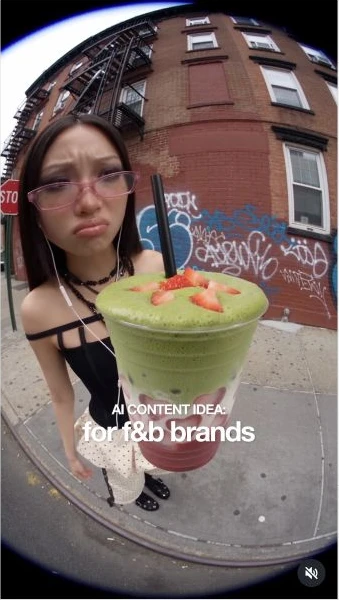
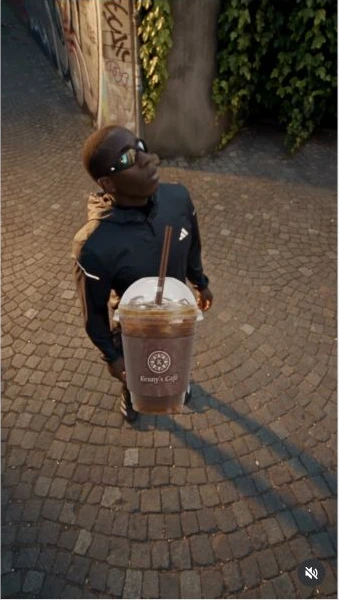
The cup stays near the center while the person moves around it. Your eye can stay put; the expression and movement do the storytelling.
Give your character a small decision to make. Keep the pause long enough to read it, then move.
03. The grab is the payoff.
We’ve seen it float. We’ve watched someone hesitate. Please let them take it.
And they do.
The runner reaches out around 0:04–0:05 and drinks at roughly 0:05–0:06.5. The woman takes the matcha and brings the straw to her mouth around 0:05–0:06.
The matcha version adds a little extra. Around 0:06–0:07, her eyes widen and her mouth opens in surprise. You get the sip, then the reaction.
Without the handoff, this would end on the same visual trick it started with. Taking the cup gives that opening somewhere to go.
The float gets the look. The grab finishes the story.
Plan the contact first: where the hand lands, how the object’s scale changes, and what happens when someone uses it.
Same setup. Two different exits.
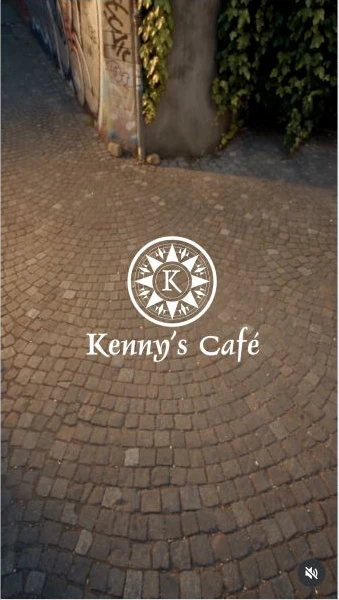
The runner heads off to the right around 0:07–0:08. A white Kenny’s Café logo stays behind.
A quick stop, a drink, then back to his day. That also fits the café’s French caption, which invites people to slow down for a cold drink before carrying on.
The matcha version leaves you with a different next step. As the woman walks away with the cup, the screen asks you to comment “MATCHA” to get the prompt, visible by about 0:08.5.
One ending serves someone curious about the effect. The other gives the café the last word. Pick the ending that fits what you want your viewer to do.
A tiny story in four beats.
Put the strange thing in plain sight.
The drink is already floating when the video starts.
Let someone clock it.
A skeptical look. A glance upward. A reason to wait for the next move.
Give us the contact.
The hand reaches out, the cup moves, the person takes a sip.
Make the exit count.
A reaction, a brand name, or a relevant next step after the grab.
Got a reference you want to unpack? Break it down with Kabo Agent, then build a new scene around your own product and audience.
Okay, how do you make it yours?
Start with a reason someone would stop.
For a bakery, imagine a pastry appearing just as someone sits down for a study break. They look around, check whether it’s meant for them, then claim it.
For a stationery brand, a pen could hover above an unfinished sketch. Someone takes it and draws the line that completes the picture.
New scenes, same useful question: what will this person do with the thing they’ve found?
If floating doesn’t fit your resources, try a practical reveal or handoff. Keep the discovery, the decision, and the payoff. Give them your own setting and a reason to happen.
Two prompts. Your next video.
Analyze both references in Kabo Agent, then use the rewrite prompt in the same conversation. Fill in the brackets before sending.
Analyze the Floating Drink format in these two reference videos:
https://www.instagram.com/p/DdYaiTmSuiw/
https://www.instagram.com/p/DdQtR1it9gI/

Inspect both actual videos first. If either is unavailable, identify which one and ask for an uploaded video or a complete screen recording with audio. Do not infer unseen actions from a cover image, caption, or this prompt.

Write a practical breakdown in natural English. Separate visible evidence from interpretation. Trace each video's opening object, passerby's entrance, discovery, hesitation, grab, use, and exit using approximate timestamps. Quote dialogue or screen text only when verified; distinguish it from the post caption. Discuss audio only if you can hear it.

Explain how framing, scale, product placement, character movement, expressions, and pauses create or resolve a specific question. Pay attention to the handoff from floating object to held product. Compare the two versions without forcing identical explanations: what does the curious passerby add, what does the runner add, and how do the endings serve different goals?

Recommend three distinct screenshot moments, with timestamps and an explanation of what each demonstrates. Suggest a side-by-side comparison only when it reveals a meaningful difference.

Finish with three techniques I could adapt to drinks, food, or another product, plus one limitation of the evidence. Do not invent views, retention, conversions, audience reactions, production tools, or causal performance claims. Cite the source of any performance figure you include.
Help me create an original short video using the Floating Drink format as a reference:
https://www.instagram.com/p/DdYaiTmSuiw/
https://www.instagram.com/p/DdQtR1it9gI/

My topic, brand, or business: [fill in]
My drink, food, product, or main subject: [fill in]
My audience: [fill in]
My goal and desired viewer action: [fill in]
Platform and target duration: [fill in]
Setting and available people or props: [fill in]
Production resources: [phone footage / practical effects / AI tools / other]
Brand personality: [fill in]
Verified product facts we may use: [fill in]
Constraints or things to avoid: [fill in]

Use the verified breakdown from our conversation. If none exists, inspect the references first. If you cannot access them, ask for the source material before making reference-specific claims.

Propose three original concepts built around an unusual object placement, a passerby discovering it, a motivated pause, and an interaction that pays off the opening. Drinks, food, and other products are all options. Change the situation, character motivation, setting, visual treatment, and ending. Do not simply swap the cup or copy the references' people, wording, or scenes. If floating does not suit my subject or resources, suggest a practical reveal or handoff that preserves the curiosity and payoff.

Choose the strongest concept for my audience. Write a complete script in readable shot-by-shot paragraphs with approximate timing, framing, character actions, on-screen text, dialogue or voiceover where useful, audio suggestions, and a final CTA tied to my goal. Make the first frame, discovery, physical contact, payoff, and final frame specific.

Explain how to execute the key transition with my resources, including object scale, hand placement, and continuity. Identify anything that needs a production test instead of promising a flawless effect. Suggest two alternative hooks. Finish by explaining what comes from the reference structure and what makes this version original.

Use only my supplied product facts. Do not invent testimonials, customer reactions, results, or production-tool capabilities.
Sources & timing
Videos and stills: The Lit Social Club ↗ and Kenny’s Café × K Galerie ↗. Stills are cropped from the actual video playback. Timestamps are approximate and measured from the start of each Reel.
This breakdown interprets visible storytelling and the published captions. It makes no claims about retention, sales, or the production tools used. The suggested bakery and stationery scenes are original adaptation ideas.