
Finding a reference and developing an idea are different jobs. Here we skip the discovery loop and work on the creative decision itself: what the viewer learns, what we add and which proof our materials can supply.
Kabo, an AI agent for creator research, can supply evidence for a selected reference; Muse helps transform its useful mechanism into a new viewer decision we can demonstrate.
Start with a reference we already chose
This guide begins after the search. Bring one to three references we have accepted, with a note explaining what the evidence actually shows. If we still need candidates, use the Muse Reels shortlist workflow first.
The creative question is now different: which useful mechanism could help our viewers make a decision, and what can we contribute ourselves? We’ll use a florist with leftover stems and two containers to work through that choice.
Prepare the materials for this Muse task
Keep the source observations next to the materials we own. That makes it harder for an attractive reference to smuggle unavailable props into the idea.
[ ] Accepted references — Public URLs plus the observation that made each useful.
[ ] Evidence notes — Caption, transcript or checked visual observation; mark any uncertainty.
[ ] Viewer decision — What our audience needs help choosing or doing.
[ ] Owned materials — In the example: leftover stems, a tall container, a short container and a phone.
[ ] Recent posts — Similar ideas we already published.
[ ] Constraints — One tabletop shoot; no event setup or delivery footage.
Connect Kabo
Use the Muse connection guide to connect https://kabo.sh/mcp-pub and sign in. Ask Muse to show the ready Kabo tools before requesting fresh research.
Separate the mechanism from the reference’s expression
Ask Muse to break a reference into three parts: what is observed, why it may help the viewer, and what belongs to the reference creator. A useful mechanism might be comparing one material under two constraints. The distinctive bouquet, wording and shot sequence are not a reusable idea packet.
If all we have is caption evidence, the observation needs to stay at that level. We can propose a comparison without claiming the reference’s first shot revealed one.
Using the accepted URLs and evidence notes above, separate source observation, possible creative mechanism and the reference creator’s distinctive expression. Label interpretations. Identify one mechanism that could help our viewer decision without copying wording, design or shot order. Flag anything needing video inspection rather than inferring it from a caption.
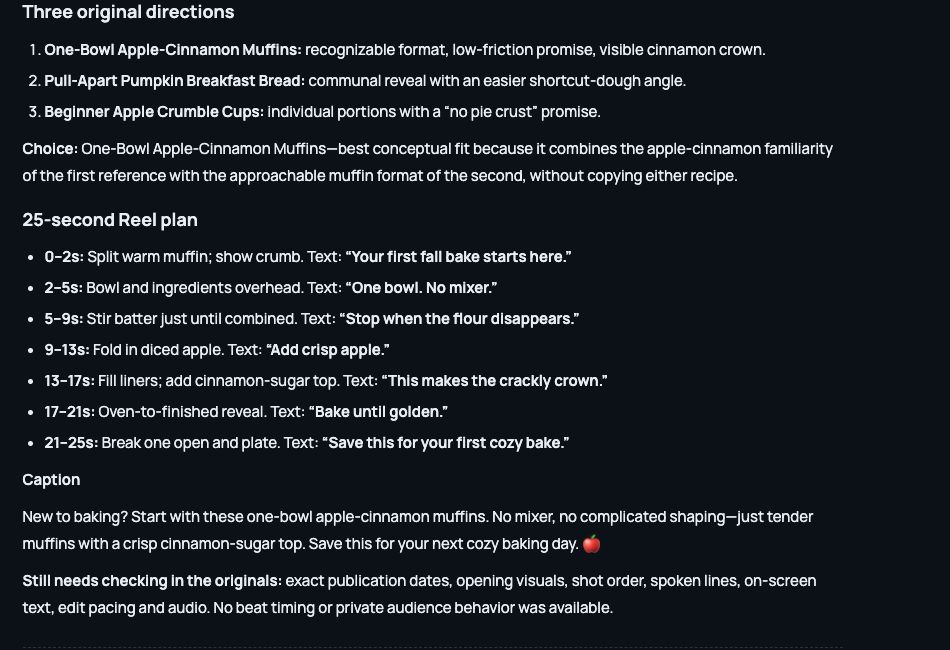
Compare the new viewer decisions, not just the titles
Here are three authored directions for our florist:
- Container choice: the same leftover stems in a tall and short container. The viewer learns what changes when choosing a vessel. We need to build both arrangements.
- Editing a small arrangement: show which stems we decide to remove and why. The viewer follows a composition decision. We need a clear before-and-after and our own explanation.
- An event-sized reveal: potentially impressive, but it needs material and access we do not have. Park it.
The first two are different teaching decisions, even if both use flowers on a table. The third is not rescued by a more exciting title.
Propose 3 angles using the selected mechanism and only our listed materials. For each, state the viewer decision, our new contribution, proof we must film and the main production tradeoff. Check recent posts for overlap. Recommend one angle and explain why the others should be revised or parked. Do not write full scripts or predict views.
Turn the selected decision into a small filming test
We choose container choice because we can demonstrate it in one sitting. The brief needs the comparison, not a copy of the reference’s reveal.
An illustrative test: place both containers and the same stems on the table; ask “What changes if these are all the flowers we have?”; build both versions; explain the decisions our own footage can show. Before recording narration, check that the comparison actually communicates the intended lesson.
The shot list should tell us what to prove. A pretty cutaway that does not help the container decision is optional.
Develop only the container-choice angle. Use the leftover stems and two listed containers. Give the viewer promise, the comparison we will demonstrate, an opening question, 4 necessary shots and any unresolved technical explanation for the florist to check. Remove the event reveal and unlisted props. Keep source notes separate from the spoken copy.
Let the filming test choose the finished angle
If the container difference reads clearly, take the brief into filming and our usual editor, such as CapCut. If the test does not answer the viewer’s question, change the demonstration before polishing narration.
Keep the rejected angles with one reason each. That preserves a useful creative decision without starting a new trend search every time a prop changes.
Worked examples are illustrative. Product screenshots show existing Kabo web results, not a run of the example in this guide. Use your own materials and the evidence returned in your task.