
We can learn more from five relevant explanations than from fifty loosely related links. This workflow starts with the decision we’re trying to make, then uses conversation to improve the sample. Our example is a dance teacher researching how to explain transitions, rather than copying someone else’s routine.
Kabo, an AI agent for creator research, retrieves the reference evidence. Muse helps narrow the teaching question as we review the candidate sources together.
Connect Kabo before asking for fresh evidence
Use the Muse connection guide to connect https://kabo.sh/mcp-pub and sign in. Ask Muse to show the ready Kabo tools before requesting fresh research.
Prepare the question and reference starting points
[ ] Research question — The precise explanation problem we want to solve.
[ ] Audience — Experience level and what viewers already understand.
[ ] Scope — Language, format and publication date window.
[ ] Our demonstration — What we can teach or show ourselves.
[ ] Seed URLs — Optional public references, with why they seem relevant.
Ask Muse for candidate relevance before a synthesis
A dance teacher is planning a beginner tutorial on remembering a short choreography sequence. They want to learn how public lessons explain transitions without committing to a large research project.
Start with the teaching question and window in one message. Ask to see a short candidate table. Reject examples whose topic is advanced performance or whose explanations do not address transitions. This is a conversation checkpoint, not a request to accept the first model summary.
I teach [audience]. Research public YouTube videos about [specific question] in [language], published from [start] to [end]. Use Kabo and show a small candidate table with URLs, dates and relevance notes first. Our own demonstration is [material]. Don’t write the lesson plan yet.
Use Kabo to inspect the useful explanations
For the relevant shortlist, gather available public metrics and transcript evidence. Keep source notes about what the teacher actually says apart from your interpretation of its teaching value. A transcript cannot establish the movement shown in a silent demonstration; inspect that video or propose a saved analysis when needed.
Keep the date window when narrowing the question. Otherwise a follow-up can quietly swap the evidence set and make the second answer look like a correction when it’s really a different study.
For a silent demonstration, the video-analysis workflow explains how to ask a visual question rather than infer movement from a transcript.
For the sources we accepted, use Kabo’s available metadata and transcript evidence to compare how the question is explained. Separate what the speaker says from your teaching interpretation. Mark visual claims needing inspection. Return a copyable memo with source links, the most useful explanation choices and one plan using our own demonstration.
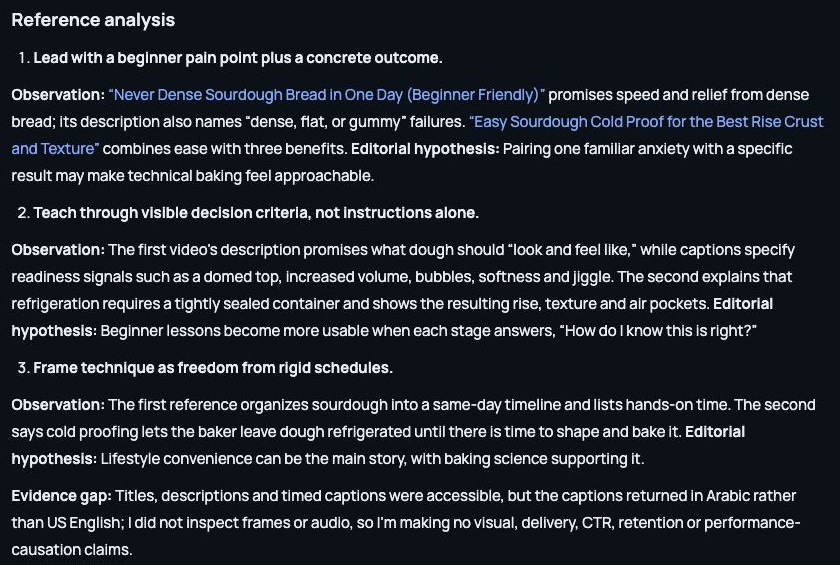
Narrow the question in a second turn
If the first report is mostly about memorizing whole routines, ask Muse to focus on the join between phrases. Keep the original dates and inclusion rules. You can request a smaller answer rather than expanding to an unrelated set of memory tips.
Turn the finding into your own rehearsal brief
Ask for a short plan with the transition question, owned demonstration and what to check during rehearsal. Copy the source list and the plan into your teaching notes. Your own choreography provides the lesson material; reference research helps you decide how to explain it.
A proposed teaching decision
For our dance teacher, the useful distinction is between remembering a whole routine and practicing the join between two phrases:
- Lesson focus: Practice the end of one phrase with the beginning of the next.
- Own demonstration: Record our four phrases and their joins.
- Reference question: How do the retrieved lessons explain transitions?
- Evidence to attach: Source URLs and supported explanation notes.
- Do not copy: Another teacher’s choreography or distinctive spoken sequence.
These examples discuss whole-routine memorization. Focus on moving from one phrase to the next, and show which retrieved sources actually address that.
Rehearse the difficult explanation from the memo
Copy the memo into Google Docs or your teaching notes. Record your own rehearsal example before deciding the final script, and keep the relevant source links for anyone reviewing the lesson.
Public views do not reveal watch time, audience retention, revenue or why a video performed as it did. Bring your own YouTube Studio export if the decision depends on private channel analytics.
Worked examples are illustrative. Product screenshots show existing Kabo web results, not a run of the example in this guide. Use your own materials and the evidence returned in your task.