
A trend with visible examples
The supplied eight-post discovery snapshot lists @leehoustonx’s version at 10.6M views and @kkubi99’s at 3.1M views.
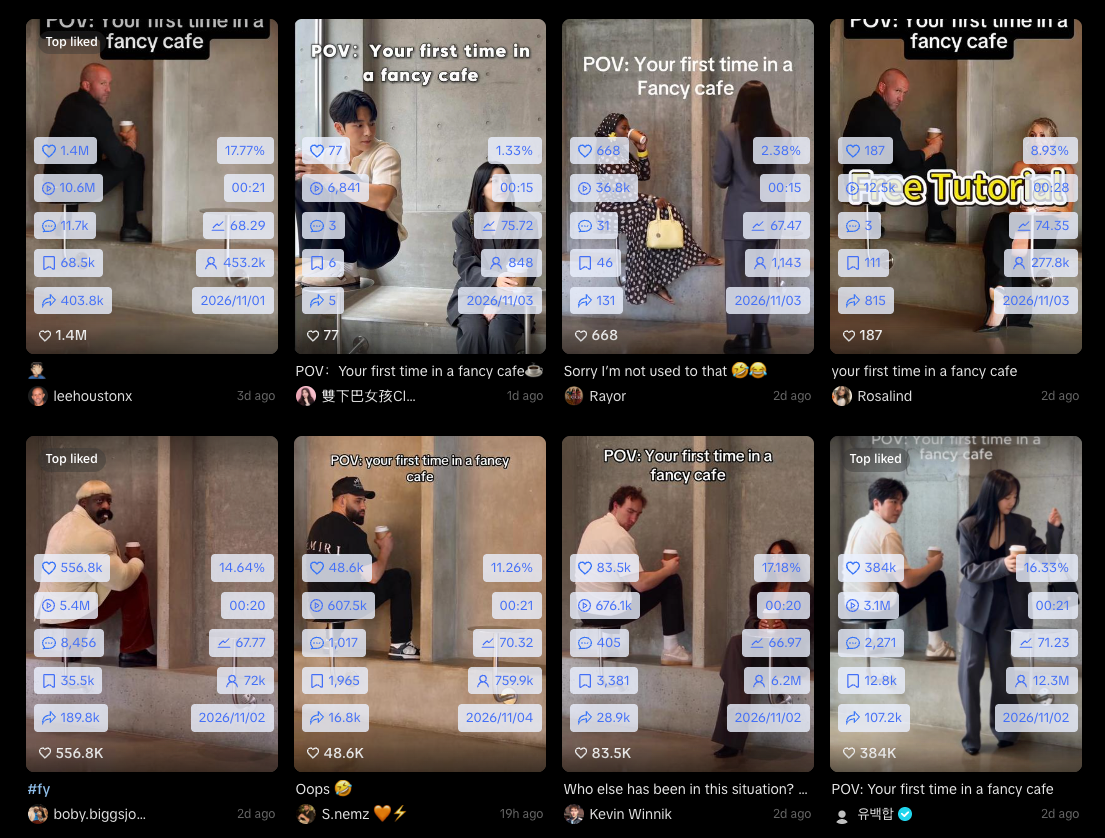
Separately, these were the public-player counts checked on November 5, 2026:
| Reference | Likes | Shares |
|---|---|---|
| @uespiiiii.1115 | 74.5K | 4,197 |
| @leehoustonx | 1.4M | 404K |
| @kkubi99 | 384.5K | 107.4K |
The view figures come from the supplied discovery screenshot; the likes and shares come from the public players. This is a selected sample, not a total for the trend.
01. The cultural joke arrives before the action.
The opening text reads:
“POV: Your first time in a fancy cafe”
That line does more than identify a location. It gives the strange furniture a social explanation.
Read the scene as a little roast of style-first cafés: everything looks carefully designed, but a basic activity suddenly requires advanced knowledge.
The room is sparse. The metal surfaces are tiny. The customer is trying to have a completely normal coffee.
Already a situation.
The relatable feeling is bigger than this particular room: everyone else seems to understand the rules, and you’re quietly trying to catch up.
02. Keep the world recognizable. Change who gets embarrassed.
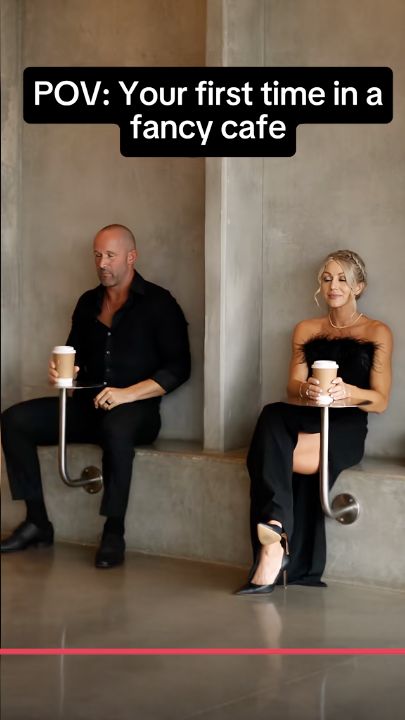
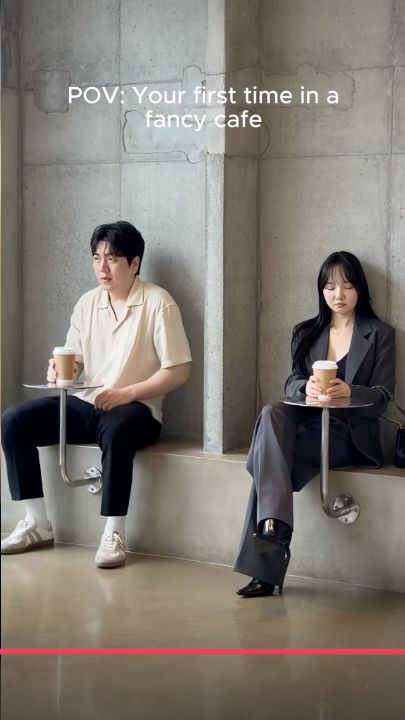
The @leehoustonx and @kkubi99 versions share a closely matched setup.
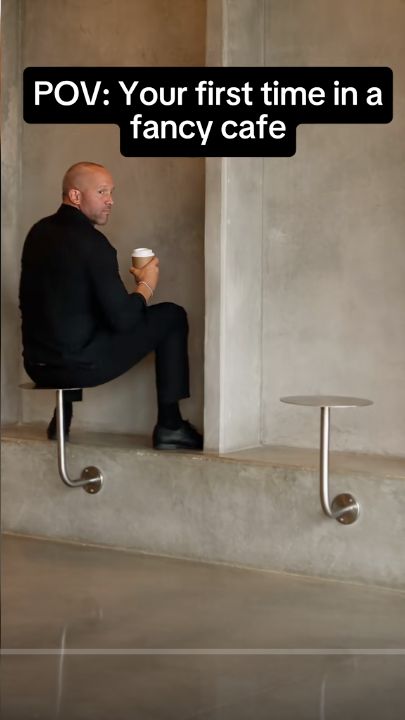
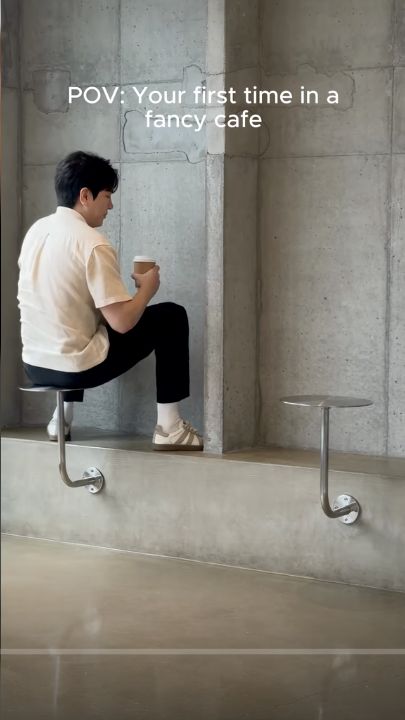
In both, around 0:01, the man is perched on the round metal surface, with his feet on the concrete ledge.
Then another customer arrives.
In @leehoustonx’s version, the woman enters around 0:07 and is seated on the ledge by about 0:10, using the metal surface in front of her for her cup. Around 0:14, his sideways look makes the comparison explicit. By roughly 0:18, he has moved down beside her.
The @kkubi99 version keeps that same broad direction: the arriving woman is seated on the ledge by around 0:14; by about 0:18, the man has adjusted his position too.
The casting and styling change. A black outfit and evening dress become a cream shirt and dark trouser suit. The text treatment changes too: a black-backed caption in one version, plain white lettering in the other.
But the visual question stays readable:
Wait. Am I sitting on the table?
That recognizable setup gives a remake something to preserve while introducing a new cast.
03. The Wes-P version flips the joke.
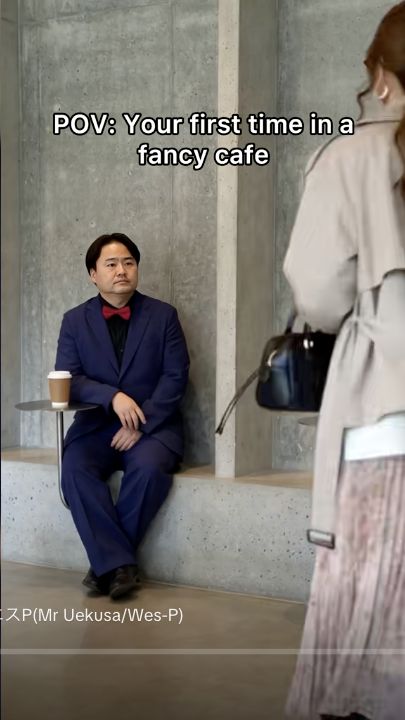
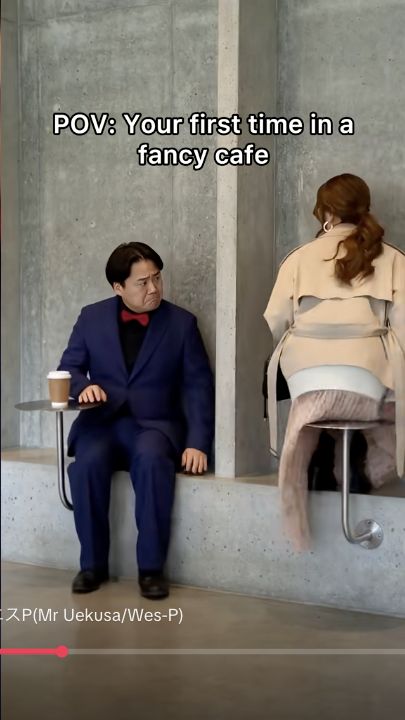
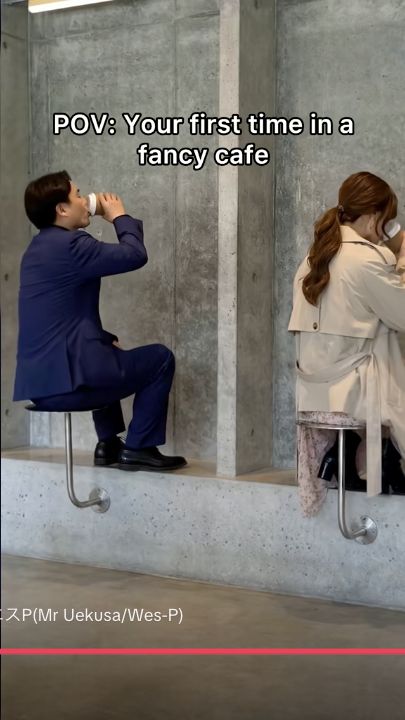
The @uespiiiii.1115 reference takes the same furniture problem in the opposite direction.
At the start, he is sitting on the ledge with his cup on the metal surface.
Around 0:04–0:06, the woman perches on the matching surface and faces the wall. He looks over, tightens his expression, and starts adjusting.
By about 0:12, he has climbed onto the ledge and perched on his own metal disc. Around 0:14–0:15, both are facing the wall and drinking.
The other two versions move toward a more familiar seating arrangement. This one ends with both people calmly committed to the stranger arrangement.
Apparently, the wall has excellent ambience. 😭
That difference matters. Borrowing a format can include changing the direction of the punchline—not just replacing a face.
04. AI makes the format something people can participate in.
This part is visible in the references.
TikTok’s public player marks the @kkubi99 post as creator-labeled AI-generated.
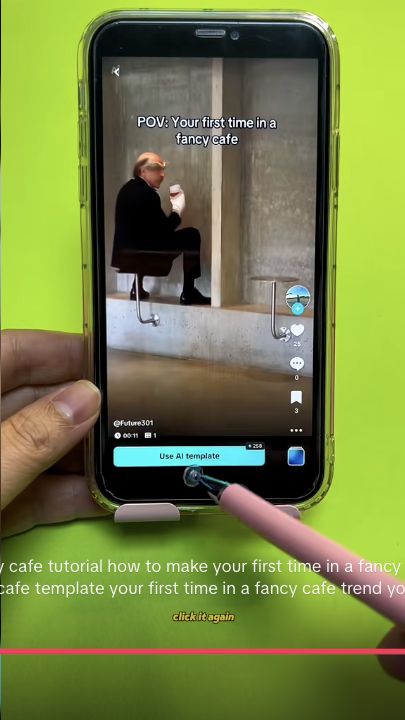
The Rosalind tutorial goes further. It opens with café examples, then switches to a phone demonstration around the middle of the video.
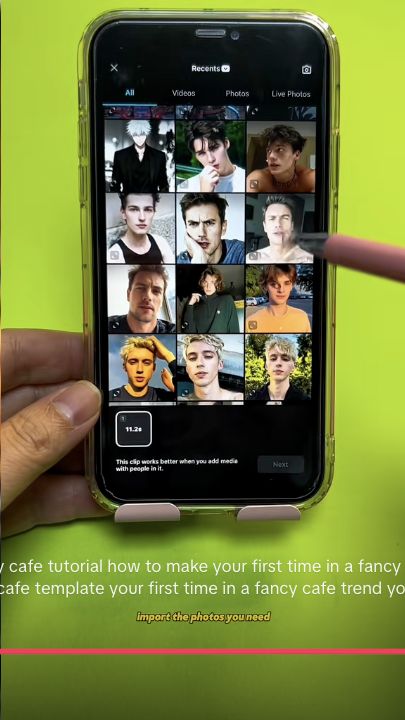
Around 0:24, the phone displays “Use AI template.” Around 0:26, the tutorial shows a photo-selection screen and an instruction to import photos.
That presents a photo-based route into the format.
You’ve seen the awkward café. Now the invitation is to put a new character inside it.
This is the useful distinction: the recurring room and seating problem make the format recognizable; the cast gives each participant something to personalize.
The evidence supports an AI-template remake angle. It doesn’t establish that every version uses the same production method.
Make your own fancy café moment ✨
Start with the feeling: trying to look comfortable somewhere you don’t quite understand.
Then decide what your version adds.
- Your character: an excessively formal host, an overconfident regular, or your own on-camera persona.
- Your reaction: a tiny double-take, a painfully slow correction, or immediate commitment to the wrong interpretation.
- Your ending: does the character figure things out—or make the situation even stranger?
Keep the object, starting position, and final position easy to compare. Give the reaction enough space to become a physical decision.
AI can help change the cast. Your creative contribution is what that character does with the misunderstanding.
Two prompts. Your own version.
Use the first prompt to compare the references. Use the second to develop and generate your own contribution to the format.
View full prompt
Analyze these reference videos as examples of the “first time in a fancy café” format:

1. https://www.tiktok.com/@uespiiiii.1115/video/7704335899739344135
2. https://www.tiktok.com/@leehoustonx/video/7703227788160961806
3. https://www.tiktok.com/@kkubi99/video/7703470179505786130
4. Tutorial: https://www.tiktok.com/@user2312450393252/video/7703661211560217869

Actually watch each available video. Do not infer its sequence or production method from the cover, title, caption, or comments. Clearly identify any video you cannot access.

Explain:
- The social situation and cultural complaint suggested by the café setting and POV text.
- The opening arrangement of people, coffee cups, ledge, and metal surfaces.
- What the arriving character demonstrates.
- The main character’s reaction and change in position.
- The final visual payoff.
- Which versions share the same direction of the joke and which reverse it.

Use approximate timestamps and compare meaningful differences in framing, text treatment, timing, character styling, and performance. Do not mechanically apply the same analysis to every version.

Identify what makes the format recognizable and what participants can personalize. Verify AI involvement through visible creator labels, tutorial steps, or other direct evidence. Distinguish AI-template remakes, face replacement, and new filming where the evidence permits; leave the exact method unconfirmed otherwise. Do not assume celebrity resemblance establishes the identity of a participant.

For metrics, record the source, retrieval time, and display precision. If I supply a discovery screenshot, label its figures separately from freshly checked platform counts. Do not treat a selected sample as a trend-wide total or claim who started the trend without evidence. Use account-relative comparisons only with a verified, dated, comparable sample.

Finish with a concise explanation of the format’s appeal and three original ways I could participate while adding my own character, reaction, or ending.
View full prompt
Use the reference comparison in this conversation to create my own original contribution to the fancy café POV format.

My brief:
- Topic or niche: [TOPIC]
- Audience: [AUDIENCE]
- Goal: [ENTERTAIN / EXPRESS A RELATABLE FEELING / INTRODUCE A PRODUCT / OTHER]
- Platform and aspect ratio: [PLATFORM / RATIO]
- Target duration: [DURATION]
- Main character: [MY SUPPLIED PHOTO / MY PERSONA / ORIGINAL CHARACTER DESCRIPTION]
- Second character: [DESCRIPTION]
- Tone: [DEADPAN / CUTE / AWKWARD / ABSURD]
- Personal twist: [MY REACTION, PROP, RELATIONSHIP, OR NEW ENDING]
- Language: [LANGUAGE]
- Brand requirements: [REQUIREMENTS]

Keep the recognizable idea: a stylish café, an ambiguous seating arrangement, and someone trying to understand the social rules.

Choose one clear comic direction:
A. The character notices another customer’s example and awkwardly corrects their first assumption.
B. The character copies another customer and ends up in an even stranger situation.

Make that choice fit my character. Add a personal reaction or ending so the result contributes something beyond changing the cast. Do not automatically reverse the action order or copy a reference performer’s exact appearance.

Develop:
1. A concise concept explaining my contribution.
2. A short opening POV caption.
3. A timestamped beat sheet with setup, demonstration, reaction, adjustment, and final payoff.
4. A shot plan that keeps the relevant people, cup, ledge, and surfaces readable.
5. A complete video-generation prompt, including character appearance, wardrobe, expressions, movements, camera position, lighting, and continuity.

Use my supplied photo or the original character description consistently. Keep the geography and props stable so viewers can compare the starting arrangement with the ending.

Generate the video using Kabo’s available video-generation workflow, then return the finished video, script, and generation prompt. If generation is unavailable, state that clearly and provide the complete production plan.
Sources & timing
The analysis compares three performance videos and one tutorial linked above. These references do not establish who originated the trend.
Public-player counts were checked on November 5, 2026: @uespiiiii.1115 at 10:28, @leehoustonx at 10:42, and @kkubi99 at 10:43, all UTC+8. Rounded figures retain the platform’s display precision. Discovery-screenshot view counts were not independently refreshed.
Time points are approximate browser playback positions. The analysis covers visible actions, text, and the tutorial’s displayed interface; audio was not assessed.