
About Dominic
Dominic runs Scalr Studio, an agency in South Africa helping online coaches improve their Instagram content and attract potential clients. He uses Kabo for the research behind his prospecting and outreach.
THE CHALLENGE
Before Kabo
Every prospect brings a different offer, audience, and content strategy. Dominic needs to find an opportunity his agency can help with, then turn it into a reason to get in touch.
He wanted a tool that could take an Instagram profile link and give him account findings to work with. Kabo became that starting point.
Kabo stood out because I could run an audit without signing up, making it easier to test and incorporate into my workflow.
DominicScalr Studio · South Africa
THE WORKFLOW
The solution
Dominic starts by pasting a prospect’s Instagram profile link into Kabo Agent. He asks for an account review against his own research brief, looking for a specific opportunity his agency could help with.
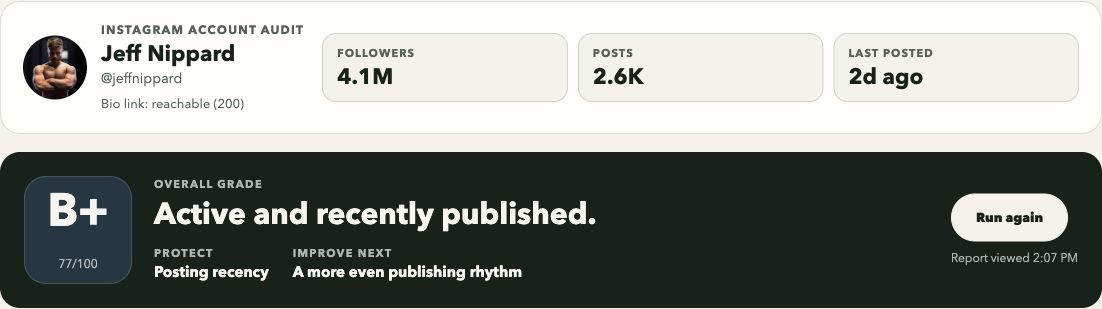
To try the profile-link step yourself, open the Instagram Account Audit, enter a username or profile URL, and select “Audit account.” The public audit is a starting point; Dominic’s brief adds the questions that matter to his outreach.
One brief, then the next profile.
In one October 2026 conversation, Dominic submitted 88 different Instagram profiles to Kabo. Of his 102 recorded requests, 87 were simply profile links. The brief stayed in the conversation; the next prospect started with a link.
For his agency workflow, he gave Kabo six checks to work through:
- Bio and positioning: Is it clear who the coach helps, what outcome they offer, and why someone should trust them?
- Content mix: Do posts show expertise through tips, process, or client wins—or lean mainly on motivational content?
- Social proof: Are client results and testimonials visible, and do they support the coach’s claims?
- Posting patterns: Is the account active and consistent, or are there long gaps?
- Conversion path: Is there a clear next step through the bio link, a call to action, or a DM prompt?
- Engagement: How do visible interactions compare with the follower count?
His rule: find one real, specific gap. If the account looks strong, say so rather than force a pitch.

Choose the issue that matters.
The account analysis he asks for connects the profile’s positioning, recent content, visible proof, posting activity, engagement, and path to becoming a client. He wants to know which observable gap gives him a useful reason to reach out.
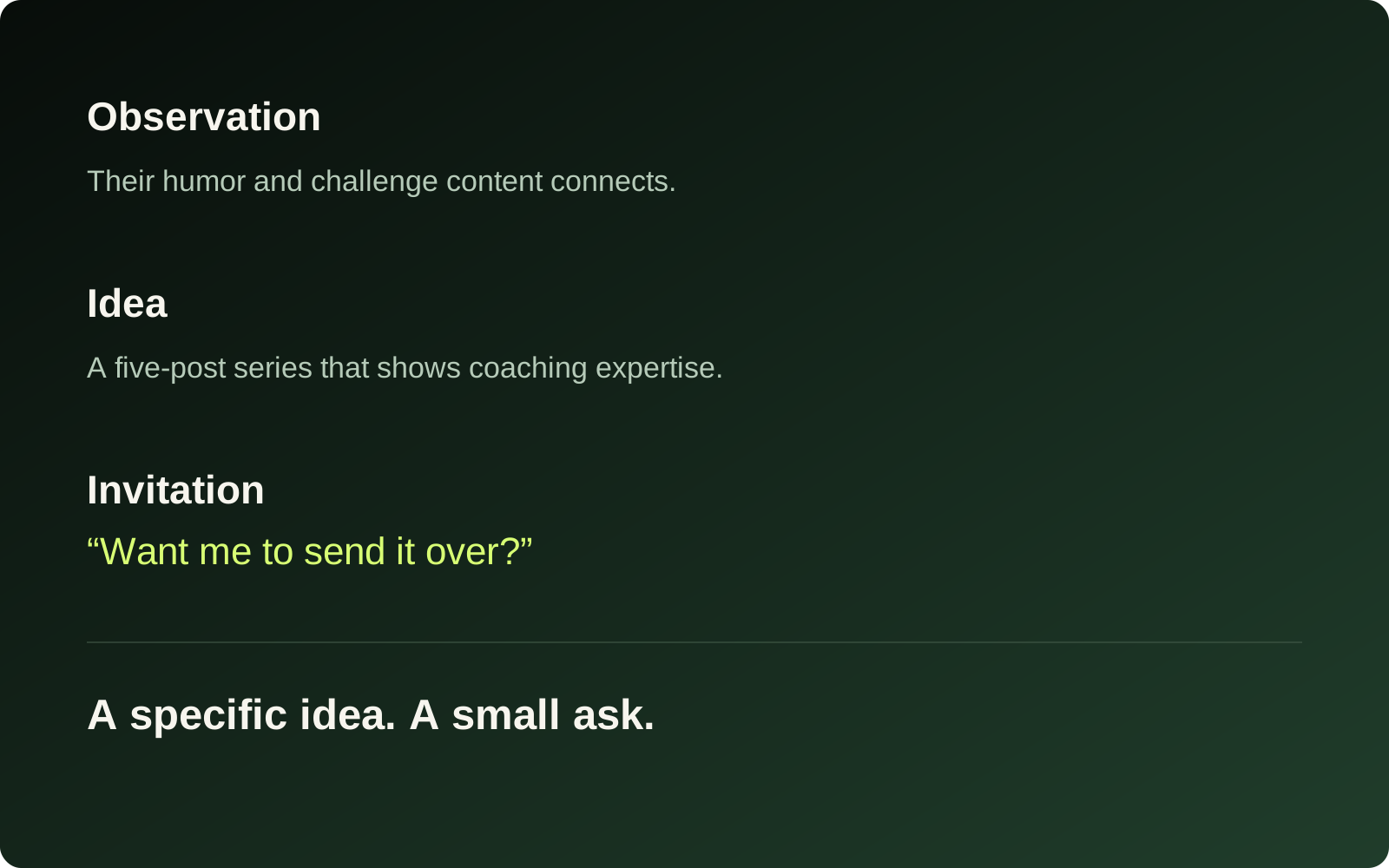
For example, his brief asks whether a coach’s posts demonstrate their expertise, not just attract attention. One message he later shared proposed a five-post series that kept the coach’s humor and challenge format while making their coaching expertise clearer. Dominic chooses the business priority, shapes the recommendation, and sends the outreach himself.
I identify the issues that matter most for their business rather than simply relying on the overall score.
DominicScalr Studio · South Africa
THE OUTCOME
Research with a next step.
On three separate occasions, Dominic came back to report that a coach had said yes or agreed to hear more. His opening messages asked permission to share an idea or a quick audit, giving those replies a clear next step.
One outreach message he shared offered a five-post series built around a coach’s existing content. Later, he asked Kabo for help with follow-up wording. The account research was becoming something he could use: a specific idea to introduce, a reason to keep talking, and a follow-up to work on.
Try the workflow.
Start with one prospect. Review the account, choose one opportunity that matters to the business, and turn it into a practical suggestion.
Copy the prospect-research note
Prospect: [Name and Instagram profile]
Research time: [Minutes from profile link to usable recommendation]
Account finding: [An issue supported by the analysis or profile]
Why it matters: [Connection to this business and target audience]
My recommendation: [One practical change or test]
Outreach angle: [The observation I’ll lead with]
Follow-up: [Reply, next conversation, or further context needed]
Based on Dominic’s interview and one October 2026 conversation. Profile counts describe submissions; responses are self-reported. Product images show a public demonstration, not his prospect accounts.