Enter a public youtube account
A handle or a profile URL. Leave it blank and type a topic instead if you are still picking a lane. Private accounts cannot be read.
Find your rival channels
Enter any public channel and get the others working your lane — each with the reason it matched and two recent videos you can open and judge for yourself. Free, no account needed.
A handle or a profile URL. Leave it blank and type a topic instead if you are still picking a lane. Private accounts cannot be read.
Every row says what the two channels have in common and links two recent posts that showed it. If the posts do not look like yours, the match is wrong — that is the point of showing them.
What repeats across several matched channels is the format the subject currently rewards. One account's best post can be luck; a format repeating across peers usually is not.
· Capture date
Run with the input below. This saved sample shows what the tool returned on the capture date; it is not a live lookup.
Output excerpts below retain their original wording. Dates and counts belong to this captured sample, not current account totals or search volume.
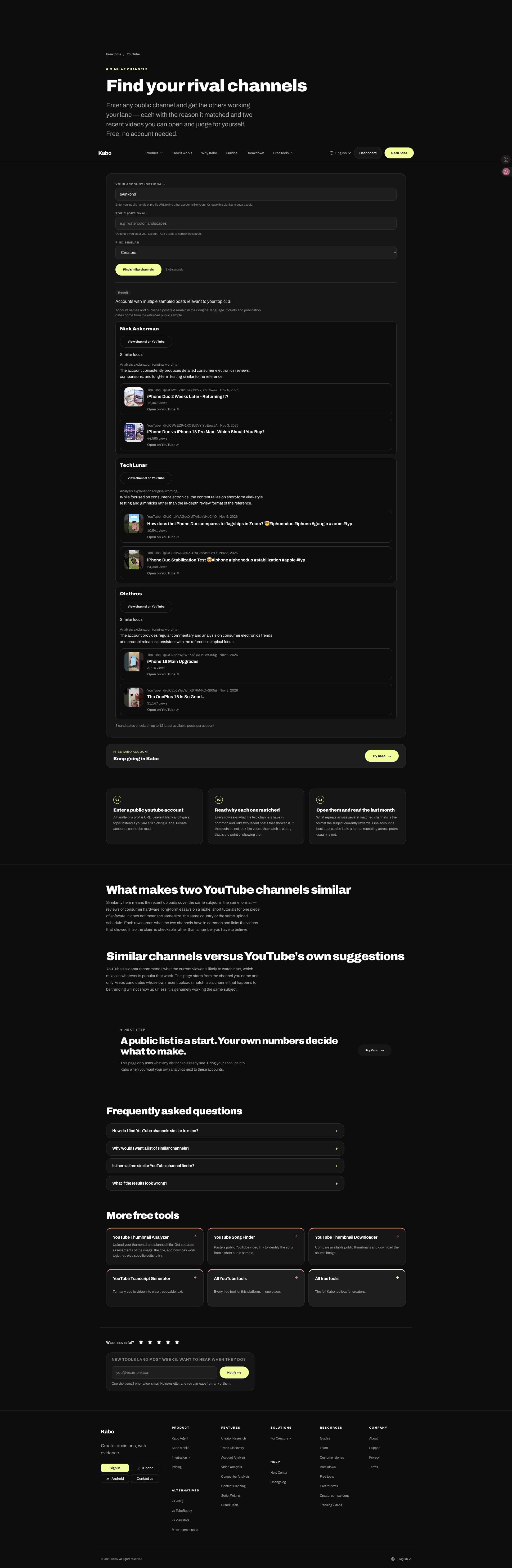
The account consistently produces detailed consumer electronics reviews, comparisons, and long-term testing similar to the reference.
While focused on consumer electronics, the content relies on short-form viral-style testing and gimmicks rather than the in-depth review format of the reference.
The account provides regular commentary and analysis on consumer electronics trends and product releases consistent with the reference's topical focus.
We submitted @mkbhd with the creator option and no extra topic. The run returned Nick Ackerman, TechLunar and Olethros, with an explanation and two linked posts for each. Start from an account when you want that creator’s context; add a topic only when you need to narrow the task.
Nick Ackerman’s returned explanation points to detailed reviews and comparisons. TechLunar’s explanation explicitly contrasts short tests with the reference’s deeper review format. Keep that mismatch visible: a returned candidate is a lead to review, and neither a shared topic nor this explanation proves shared audiences.
Open both evidence videos, record the subject and format, then keep only channels useful for your question. Audit a shortlisted channel to inspect public consistency and engagement, or use the ideas tool to develop a distinct angle. Do not treat a candidate list as a sponsorship recommendation.
Similarity here means the recent uploads cover the same subject in the same format — reviews of consumer hardware, long-form essays on a niche, short tutorials for one piece of software. It does not mean the same size, the same country or the same upload schedule. Each row names what the two channels have in common and links the videos that showed it, so the claim is checkable rather than a number you have to believe.
YouTube's sidebar recommends what the current viewer is likely to watch next, which mixes in whatever is popular that week. This page starts from the channel you name and only keeps candidates whose own recent uploads match, so a channel that happens to be trending will not show up unless it is genuinely working the same subject.
This page only uses what any visitor can already see. Bring your account into Kabo when you want your own analytics next to these accounts.
Enter your channel below. Kabo reads the recent public uploads of candidate channels and keeps the ones actually making the same kind of video, then shows you the two videos that decided each match. Subscriber count alone is a poor similarity signal — a 40k channel covering your exact topic is a closer neighbour than a 4M channel that touched it once.
Three uses that pay off: seeing which titles and formats already work in your lane before you commit a week to filming, finding channels worth a collaboration or a shout-out swap, and giving a brand a credible answer when they ask who else is in this space.
This one. It's free with no account needed, and every result links back to the public videos it used, so you can check the match rather than trust a score.
Open the two example videos on each row. If they are not the same kind of video you make, the match is wrong and you should say so — the reason line exists precisely so a bad match is visible instead of hidden behind a percentage.