
The point of competitor research is to make a better decision for our account. We’ll compare formats and viewer questions before chasing a winner. An equipment-free movement educator is our example; the same method can help a studio, retailer or other teaching account choose what to try next.
Kabo, an AI agent for creator research, returns public posts. We’ll use Muse to correct a few comparison rows in conversation before trusting a format recommendation.
Connect Kabo before asking for fresh evidence
Use the Muse connection guide to connect https://kabo.sh/mcp-pub and sign in. Ask Muse to show the ready Kabo tools before requesting fresh research.
Prepare the peer set and comparison window
[ ] Accounts — 3 public Instagram URLs and why they serve a similar audience need.
[ ] Shared dates — One publication window for every account.
[ ] Categories — Viewer question, format, required equipment and explanation style.
[ ] Our constraints — What we can film and which claims need expert review.
[ ] Output destination — A document or sheet where we’ll copy the reviewed matrix.
Tell Muse why these accounts belong together
A movement educator is developing equipment-free desk-break content. They want to compare the public content choices of three accounts without pretending to know those accounts’ private reach or business results.
Paste the account URLs and explain the overlap in audience need. Ask Muse to repeat the shared window and categories before collecting. An account can be a creative reference without being a fair performance peer. Keep that distinction visible in the table.
Compare these public Instagram accounts: [URLs]. Our audience needs [problem]. Use the same [start] to [end] publication window. Before collection, propose the categories and explain which accounts are fair peers versus creative references. Keep Reels, carousels and static posts separate.
Review a few rows before accepting the account story
Ask Muse for the included post count and coverage notes, then inspect a small comparison sample. Start with the evidence type and the category assigned to each row. We should be able to explain why a caption, spoken instruction or observed follow-along belongs under a particular label.
The first useful conversation is often about a misclassified row, not a winner.
Use Kabo for the agreed public account sample and show 3 comparison rows first. Include source URL, date, evidence type, proposed category and the observation supporting it. Keep post formats separate and report collection limits. Wait for my category corrections before summarizing the accounts.
Correct the rule, then ask which rows change
Tell Muse what the broad category concealed, and ask it to revisit rows that depended on that label. The revised answer should name the affected rows and any account-level observation that no longer holds. It should not silently reclassify every post.
Split educational into reminder, spoken explanation and observed follow-along. Revisit only rows that depended on the old label. Preserve each row’s evidence type, mark visual sequence unknown where it was not inspected, and show which account-level conclusions change.
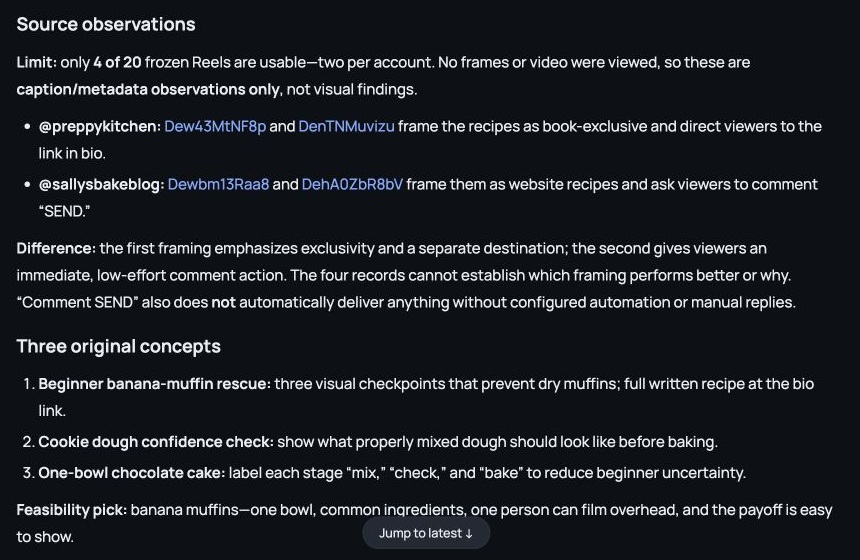
An illustrative category correction
Suppose “educational” contains these three authored examples:
- A: caption says “try this at lunch.” This supports a reminder framing; the visual sequence remains unverified.
- B: transcript explains the steps. This supports a spoken explanation, not necessarily a visible follow-along.
- C: we checked a follow-along sequence. This can be coded as a demonstrated routine, with that inspection recorded.
Putting all three in one bucket hides different production requirements. Splitting the category changes what we can learn from the accounts.
Choose a format using the corrected comparison
Our equipment-free educator may now see that a reminder and a follow-along require different assets. Choose one format we can demonstrate and identify what a reviewer needs to check before filming.
If a conclusion depends on shot order we have not inspected, use the Muse video-analysis workflow for that question. For public-field availability and denominator checks, the MCP Instagram guide covers the data side.
Which recommendation depended on treating spoken explanation as a visible follow-along? Revise that recommendation using the corrected rows, and list the footage or inspection still needed before we choose a format.
Take the corrected format brief to your team
Copy the corrected matrix and the chosen format note into Google Sheets. Keep the category decision next to the rows so a collaborator can review the same comparison. Use the Muse ideas guide when we are ready to develop the original angle.
Worked examples are illustrative. Product screenshots show existing Kabo web results, not a run of the example in this guide. Use your own materials and the evidence returned in your task.