
A small prop. A big difference in the numbers.
The Reel displayed approximately 323K views, 10K likes, and 32 comments when checked on November 3, 2026.
On the same account’s public Reels grid, nine other non-pinned videos had a median of 324 views. This video’s displayed total was roughly 1,000× that sample median.
That’s a snapshot comparison across videos of different ages. It doesn’t establish what caused the difference.
So what’s actually happening on screen?
01. The picture finishes the sentence.
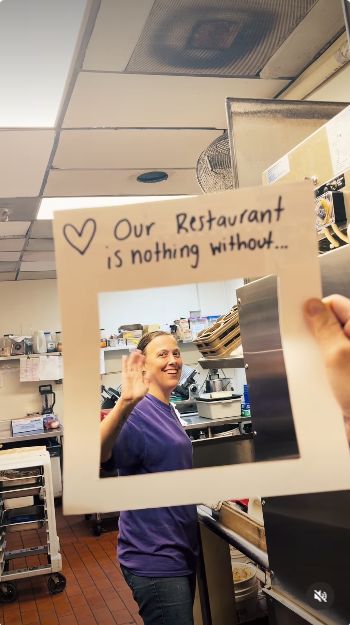
By approximately 0:01, a hand holds a white paper frame in front of a kitchen worker. A heart and a handwritten line sit above the cutout:
“Our Restaurant is nothing without…”
The missing ending is already inside the frame.
At roughly 0:01.1, the employee is looking down at her work. By 0:02.9, she looks toward the camera and smiles.
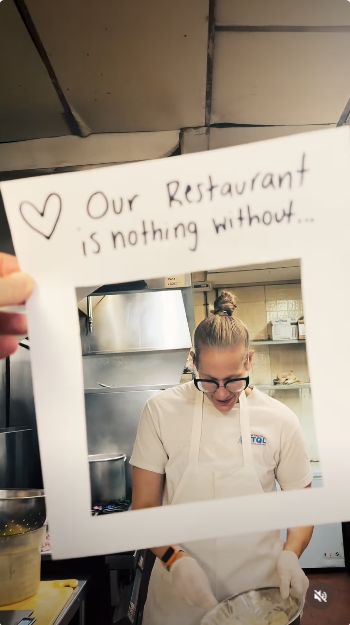
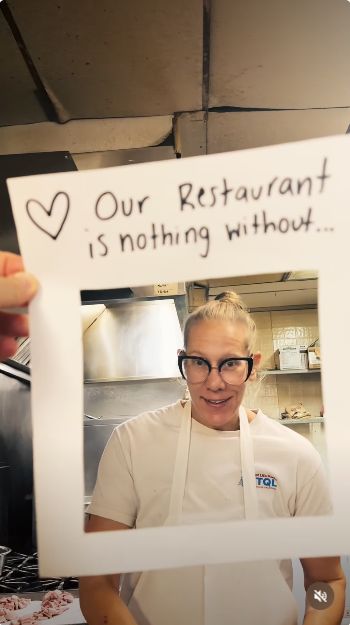
The message gets a human response before the video needs another explanation.
For your own version, write a line that a person, object, or action can visibly complete. Then put the answer in the opening shot.
02. Keep the message. Change the person.
Around 0:04.4, the frame surrounds a smiling employee in a red shirt and dark cap at the stove.
By roughly 0:06, another employee appears near the front counter, with condiments and restaurant branding around them.
At approximately 0:09.5, a different employee is working at a stove beneath a wall clock.
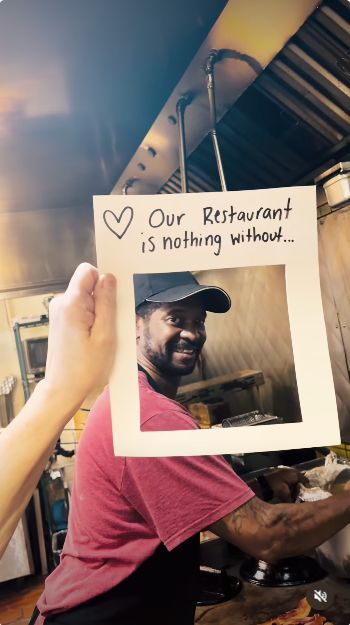
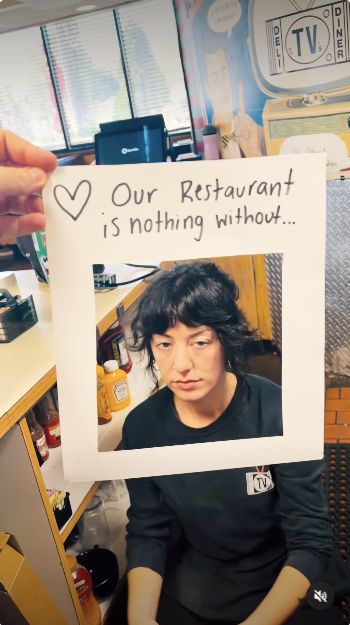
Same sentence. Different people. Different parts of the restaurant.
That repeated paper frame gives the sequence a clear structure. Each new person adds something without requiring a new headline.
You can borrow that structure for a workshop, studio, community group, or small business. Keep one visual rule consistent while changing what the audience discovers inside it.
03. Give the people a moment to respond.
Around 0:11.7, an employee in a purple top smiles and waves through the cutout.
Later, at approximately 0:17.8, the frame picks out an employee holding a receipt behind a point-of-sale monitor.
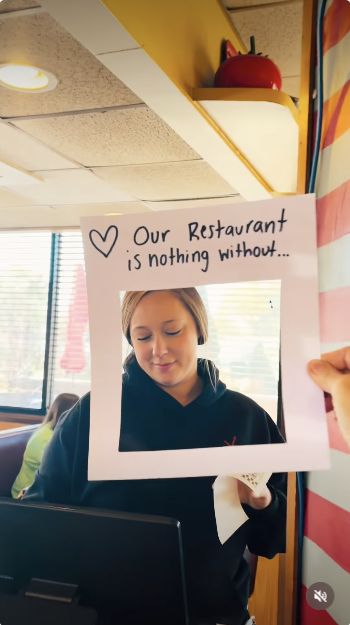
These are small details, but they give the sequence personality.
The kitchen equipment, shelves, counter, and dining area also remain visible around the paper. We see the people in the places where they work.
The handheld framing shifts and tilts between portraits. It feels like someone is moving through the restaurant to acknowledge the team.
For your version, leave room for a glance, a wave, or a small action. Give each person something more specific to do than stand inside a prop.
04. The payoff builds across the video.
In the closing section, around 0:20–0:22.5, an employee in a cap and glasses appears behind the kitchen pass, making a two-finger gesture.
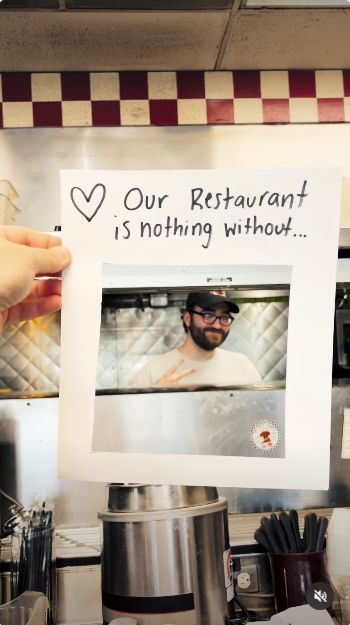
The handwritten message is still there.
By this point, we’ve seen several people complete it. The thank-you has become a collection of faces, reactions, and working environments.
This handles the paper prop differently from the Cardboard Sign Reveal. That format uses a turn of the board to introduce new information. Here, the cutout keeps presenting a new answer to the same sentence.
The ending works because the earlier portraits have accumulated meaning.
Make the frame your own.
Start with what deserves recognition in your content.
A bakery could spotlight the people behind a morning batch. A community project could introduce the volunteers behind a finished space. A maker could frame the materials and tools that become one completed object.
Then choose:
- A specific message: something your images can complete.
- A consistent visual device: a frame, opening, shape, or foreground prop.
- A changing sequence: people, places, or actions that add new information.
- A closing image: one that brings the message into focus.
Write your own line, design your own prop, and build the sequence around your subject.
Two prompts. Your own version.
Use the first prompt to examine the reference. Use the second in the same conversation to develop your original video.
View full prompt
Analyze this reference video:
https://www.instagram.com/reels/DfC74B9CWLU/

Actually watch the video before analyzing it. Do not infer its scenes, opening, ending, or editing from the caption, thumbnail, comments, or account category. If playback is unavailable, state what you cannot verify and ask me for the video file.

Create a timestamped breakdown covering:
1. What appears in the opening seconds, including the exact visible wording.
2. How the foreground paper frame relates to the person and working environment behind it.
3. How the sequence changes between people, locations, gestures, and framing.
4. How long the opening idea takes to become understandable, using observed moments rather than invented retention data.
5. What the closing shots deliver and how they relate to the opening message.
6. Which structural ideas could be adapted to another subject.

Distinguish direct observations from interpretation. Treat approximate playback timestamps as approximate; do not present them as exact cut boundaries. Assess audio or beat synchronization only if you can actually hear and verify it.

Report public metrics with their source, retrieval time, and displayed precision. If an account comparison is available, identify every sampled post, exclusions, sample size, and calculation. Do not infer retention, sales, conversion, or a causal explanation from public totals.

Finish with a concise list of transferable ideas and the specific elements that should be redesigned for an original version.
View full prompt
Use the verified reference analysis above to develop an original short video for me.

My brief:
- Brand or creator: [NAME]
- Topic or subject to spotlight: [TOPIC]
- Intended audience: [AUDIENCE]
- Main goal: [RECOGNITION / COMMUNITY / AWARENESS / OTHER]
- Platform and aspect ratio: [PLATFORM; DEFAULT 9:16]
- Target length: [SECONDS]
- Setting: [LOCATION OR ENVIRONMENT]
- People, objects, or actions to feature: [DETAILS]
- Available footage and images: [ASSETS OR NONE]
- Brand voice and visual style: [STYLE]
- Required message or CTA: [MESSAGE]
- Production constraints: [CONSTRAINTS]

Borrow the relationship between an unfinished message and the visible subject that completes it. Create an original headline, prop design, shot sequence, and ending suited to my brief.

Give me:
1. One clear concept and opening promise.
2. The exact opening text and any later on-screen wording.
3. A timestamped storyboard with subject, action, framing, foreground prop, background, transition, and intended result for each shot.
4. A closing shot that pays off the opening.
5. Complete, paste-ready video-generation prompts for each shot, including consistent people, clothing, setting, lighting, and prop design.
6. A practical assembly plan covering shot order, approximate durations, text placement, and sound direction.

Keep the key message readable. Let the people or objects change while the visual device stays consistent. Include specific reactions or actions instead of repeating an identical pose.

Use supplied footage when it fits. If people must be generated, create fictional characters. Reserve exact lettering for an editable text overlay or a verified readable prop.

If video-generation tools are available in this session, generate the proposed shots and assemble a preview where supported. Otherwise, deliver the complete storyboard and generation prompts, clearly stating what remains to be produced. Do not claim a video was generated unless a playable result exists.
Source & timing
Sources: the original Reel by @tvsdeli and the account’s public Reels grid, checked November 3, 2026, at 10:24 UTC+8.
The interface displayed 323K views and 10K likes as rounded counts, plus 32 comments.
The comparison uses the 12 Reels visible in the public grid, excluding two pinned posts and the target video. The remaining nine displayed 156, 183, 185, 410, 347, 324, 424, 5,456, and 116 views. Their median was 324; approximately 323,000 ÷ 324 gives a snapshot ratio of about 997×.
The video is approximately 24 seconds long. Timestamps refer to moments checked during browser playback, rather than exact cut boundaries. This breakdown covers the visible footage and text; audio was not assessed.